
San Francisco Bay Area Residential Market Report May 2026

Spring in the Bay Area arrived loudly this year. April closings just came in, and the numbers tell the story I've been seeing in person every weekend: San Francisco single-family homes are selling for 124.7% of list price, the highest sales-to-list ratio of any county in the state. Buyers waited out a slow 2025, watched mortgage rates slip from nearly 7% to the low 6s, and showed up for the spring market with intent. Inventory is rising, but not fast enough to keep up with the energy.
Local Market Insight
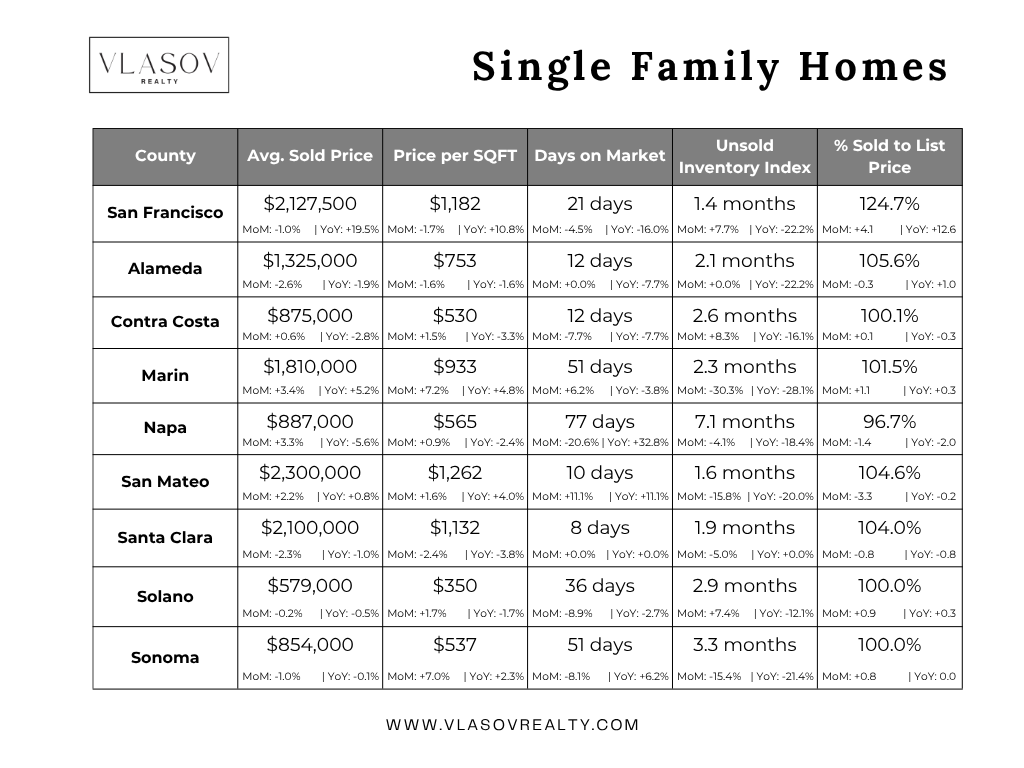
April brought a clear divide between the inner Bay Area and the outer counties. The S.F. Bay Area median for existing single-family homes held at $1,400,000, flat from March and down a modest 1.3% from a year ago, but that headline hides what is actually happening beneath the surface. Sales activity jumped 18.8% from March and 5.5% year over year, the strongest April closing volume the region has seen since 2022. San Francisco SFH prices are up 19.5% year over year to a median of $2,127,500; San Mateo set a new April record at $2,300,000; and Marin climbed 5.2% year over year to $1,810,000. Days on market in Santa Clara dropped to 8. In San Mateo, 10. These are pre-pandemic levels of competition.
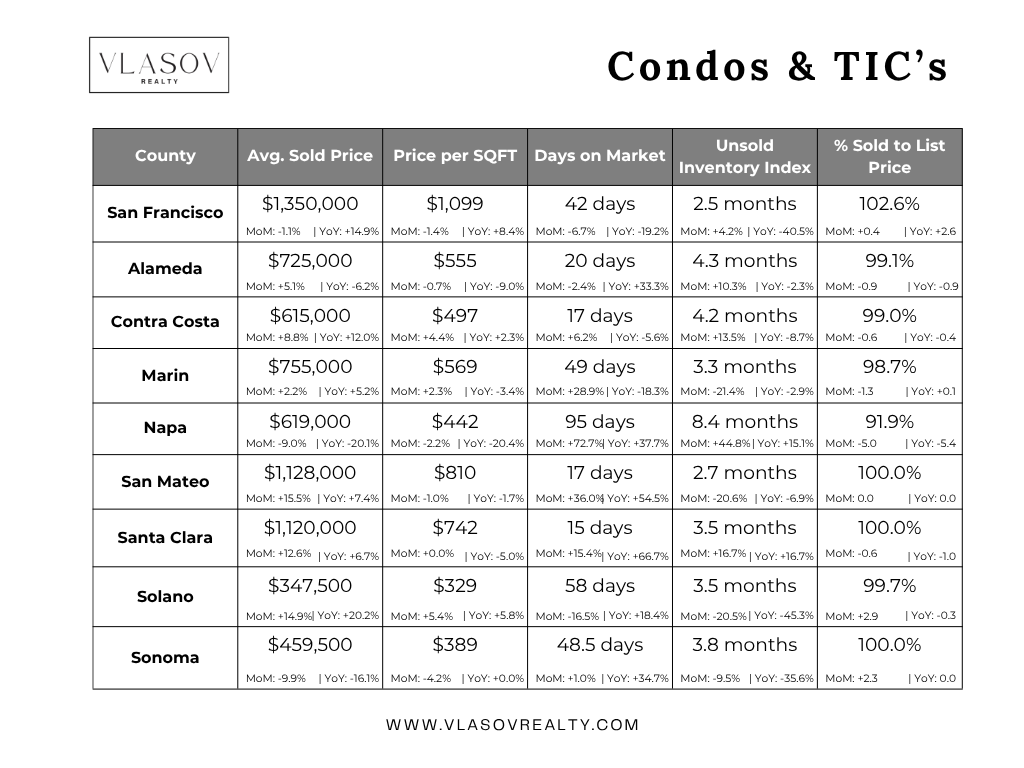
The condo and TIC market is the real story this month. Bay Area condos hit a $875,000 median, up 6.1% from March and 2.0% from last April, with sales up 5.2% year over year. San Francisco condos closed at $1,350,000, up 14.9% from April 2025. San Mateo condos jumped 15.5% in a single month. Santa Clara condos rose 12.6%. After three years of underperforming the SFH market, the condo segment is catching a bid as buyers priced out of detached homes look down-market for entry points.
What's Driving the Market
- Mortgage rates have moved into a more comfortable zone. The Freddie Mac 30-year fixed averaged 6.36% as of May 14, down 45 basis points from a year ago when rates sat at 6.81%. The 15-year is at 5.71%. Rates are not low by historical standards, but they are low enough that buyers who paused in 2024 and 2025 have re-entered the pool.
- The Fed has held the funds rate at 3.50% to 3.75% since late 2025 and is expected to stay there through summer. With April CPI at 3.8% year over year, the highest reading since May 2023 because of energy and oil pressure tied to the Middle East conflict, additional cuts this year look unlikely. Long-rate volatility is the risk, not policy easing.
- Inventory across the nine counties is climbing into the spring season, but the Bay Area unsold inventory index is 2.3 months on the SFH side, well below the 4 to 6 months considered balanced. New listings are getting absorbed within weeks. In the most active South Bay and Peninsula submarkets, well-prepared listings still draw five to ten offers.
- The AI investment wave is reshaping the buyer pool. While the broader Bay Area tech sector lost about 4,400 jobs in 2025, the AI subsegment continues to pull capital and high-wage talent into San Francisco and the Peninsula. That cohort buys homes. It is the single biggest reason San Francisco prices are setting records while other West Coast markets soften.
County Highlights
San Francisco is the most aggressive market in the state right now. The SFH median jumped to $2,127,500 in April, up 19.5% year over year, and homes are selling at 124.7% of list price, which means the typical buyer is paying about $446,000 over asking. Days on market dropped to 21. Inventory sits at just 1.4 months. On the condo side, the $1,350,000 median is up 14.9% from April 2025, with sales volume up 25.8% year over year. After years of doom-loop coverage, the SF housing market is unmistakably back, and AI money is the engine.
Alameda is in a strange position. The SFH median pulled back to $1,325,000, down 1.9% year over year, but homes are still closing at 105.6% of list with a 12-day days-on-market reading. That is a competitively priced market. The condo side is the soft spot, with the median down 6.2% year over year to $725,000 and condo days on market stretching to 20. Buyers in Oakland and Berkeley have leverage they don't have in one county to the west.
Contra Costa is a tale of two segments. SFH prices are off 2.8% year over year at $875,000, with the median holding flat. Condos are the bright story: up 12.0% year over year to $615,000, with strong May absorption. Inventory ticked up to 2.6 months on the SFH side, which gives buyers more selection than they've had in over a year, especially in Walnut Creek, Concord, and Antioch.
Marin had a breakout month. The SFH median rose to $1,810,000, up 5.2% year over year and 3.4% from March. The inventory index dropped from 3.3 months to 2.3 in a single month, the sharpest tightening of any Bay Area county. Sales were up 70% from March and 12.4% year-over-year. Buyers chased the inventory once it appeared, and listings that lingered through winter are now moving.
Napa is the outlier. The SFH median fell 5.6% year over year to $887,000, and the condo segment dropped 20.1% to $619,000 with 95 days on market. Inventory sits at 7.1 months on the SFH side, the highest in the Bay Area. Wildfire insurance pressure and the unique luxury wine-country buyer profile are showing up in the data. This is a buyer's market within a region of seller's markets.
San Mateo posted the highest median in California for SFH at $2,300,000, up 0.8% year over year and 2.2% from March. Days on market is 10. Sales rose 34.4% from March. Condos jumped 15.5% month-over-month to $1,128,000. The Peninsula remains the most consistently competitive submarket in the state, driven by the concentration of tech wealth in Palo Alto, Menlo Park, Burlingame, and the surrounding cities.
Santa Clara held at a $2,100,000 SFH median with the fastest days on market in the region at 8. Prices ticked down 1.0% year over year, but the sold-to-list ratio of 104.0% tells you everything about buyer behavior. The condo segment is up 6.7% year over year to $1,120,000, with the South Bay seeing some of the same AI-driven demand spillover from San Francisco and the Peninsula.
Solano remains the affordability play. The SFH median is $579,000, essentially flat year over year, with homes selling at exactly 100% of list. Solano condos posted the biggest year-over-year price gain in the Bay Area at 20.2%, hitting $347,500. Inventory is dropping fast, and the sub-$600,000 detached-home market is one of the few entry points for first-time Bay Area buyers.
Sonoma is mixed. SFH prices held at $854,000, basically unchanged year over year, with sales volume up 39.6% from March. Condo prices fell 16.1% year over year to $459,500. Inventory sits at 3.3 months on the SFH side, the loosest in the central Bay Area, with 51 days on market. Sonoma is a slower, more deliberative market right now, with buyers showing up but taking their time.
Macro Market Overview
Nationally, existing-home sales rose 0.2% in April to a 4.02 million annualized pace, according to NAR. The U.S. median sale price hit $417,700, up 0.9% year over year and the 34th straight month of annual price gains. Inventory nationally sits at 4.4 months, much more balanced than the Bay Area. NAR's Chief Economist Lawrence Yun noted that home sales are being modestly supported by affordability gains as mortgage rates remain below year-ago levels and income growth outpaces price growth. The market is not booming nationally. It is grinding sideways at low transaction volumes.
California is outperforming the national pace on the upside. The statewide SFH median hit $914,810 in April, up 2.9% from March and slightly above the April 2025 level. Statewide condo prices reached $675,000. C.A.R.'s most recent affordability index hit 22% for the first quarter of 2026, the highest level in four years, helped by lower rates and softer prices in Q4. The Bay Area condo recovery is consistent with the statewide pattern, where condos have become the realistic entry point for the median California household.
Economic Factors
April CPI came in at 3.8% year over year, the highest annual reading in nearly three years. Core CPI, which strips out food and energy, rose to 2.8%. The energy index alone is up 17.9% year over year, with gasoline prices up 28.4%, both driven by the prolonged Middle East conflict that has kept Brent crude above $100 a barrel. The Federal Reserve has held the funds rate target at 3.50% to 3.75% since the end of 2025 and dissented heavily at the April meeting, with four members objecting to the policy stance. Markets are now pricing zero cuts in 2026 and a roughly 40% probability of one rate hike before year-end.
The 10-year Treasury yield closed at 4.67% on May 19, the highest level in a year, after a steady rise through the spring. The S&P 500 has held near record highs despite the rate pressure, but bank stocks and energy names are leading while long-duration tech is under measurable pressure. For Bay Area buyers, the relevant signal is that long rates are unlikely to come down soon. Mortgage rates track the 10-year more than the funds rate, and unless inflation cools through summer, the affordability assumptions that supported the C.A.R. forecast of 6.0% mortgage rates by year-end now look optimistic.
Mortgage Rates
The 30-year fixed averaged 6.36% in the most recent Freddie Mac PMMS, down slightly from 6.37% the week before and meaningfully below the 6.81% reading from one year ago. The 15-year fixed rate is at 5.71%, down from 5.92% last year. Rates trended lower through February and early March on the strength of Fed cuts in late 2025, then drifted higher as inflation prints came in hot and the Treasury market repriced. Volatility has been the dominant theme, with weekly moves of 10 to 15 basis points becoming routine.
What is shaping rates from here is straightforward: inflation expectations, the federal deficit picture, and the path of oil prices. Top forecasters now have the 30-year fixed averaging in the low- to mid-6% range through year-end. The Mortgage Bankers Association sees rates ending 2026 near 6.2%, Fannie Mae is closer to 6.4%, and Bankrate's panel has the central forecast at 6.3%. The pre-pandemic 3% to 4% rates are not on anyone's radar. For Bay Area buyers, the practical implication is that the affordability math is what it is. Waiting for a major rate drop has cost buyers significantly more over the past 18 months than transacting at current levels would have.
Housing Policy and Development
- SB 79 takes effect July 1, 2026, requiring high-density transit upzoning across the Bay Area. The law overrides local single-family zoning near rail stations and rapid bus stops, allowing buildings up to 9 stories near rail stations and 5 stories near major bus corridors. This is the most consequential land-use change in California in a generation.
- AB 130 and SB 131, in effect since January 1, created broad new CEQA exemptions for infill housing projects, a long-sought streamlining that will accelerate multifamily construction in cities including San Francisco, Oakland, and San Jose.
- SB 543 streamlined ADU approvals statewide, requiring local agencies to complete a permit review within 15 business days and approve or deny within 60 days. Missed deadlines result in automatic approval. The law also exempts ADUs under 500 square feet from school impact fees.
- AB 462 created a 60-day approval window for coastal-zone ADUs, opening up Marin and the San Mateo coast to development that had been effectively blocked.
- AB 1061 expanded SB 9 eligibility to allow urban lot splits and two-unit developments in historic districts, which removes a significant barrier in older neighborhoods in San Francisco, Oakland, and Berkeley.
- California's home insurance market remains a wildcard. Insurer pullbacks continue in wildfire-exposed areas of Marin, Sonoma, and Napa, and several major carriers are still limiting new policies. This is a real constraint on transactions in those counties.
Local Sentiment
What I'm seeing on the ground matches the data and then some. Open houses in San Francisco and the Peninsula have lines down the block. I had a Burlingame listing draw 17 offers last week and close at 38% over asking. A San Carlos home went 42% over with 22 days on the market. Even the markets the data suggests are softening, like parts of Alameda, are seeing strong activity on well-priced, well-prepared listings. Buyers are not casual. They are pre-approved, they have looked at the comps, and they are committing.
The condo story is the one most agents are still adjusting to. After years of underperformance, SF and Peninsula condos are absorbing quickly, and buyers who sat on the sidelines through 2024 are now competing for the same units. Inventory is rising, but it is being absorbed almost as fast as it is listed. The supply story is more flow than stock.
If you've been waiting for a sign to make a move, this is the most active spring market the Bay Area has seen in three years. Whether you are thinking about selling and want to know what your home is worth in this environment, or you are sizing up the math on a purchase, I'm always happy to walk through your specific situation. No pressure, no pitch, just a real conversation about your numbers and your goals.
Categories
Recent Posts









Stay In The Know - Subscribe To Market Updates
LET'S GET IN TOUCH