
Bay Area Residential Market Report: July 2026

Bay Area Residential Market Report: July 2026
Summer in the Bay Area usually means the market takes a breath. Not this year. Buyers moved through June with mortgage rates still hovering in the mid 6% range and a fresh wave of AI compensation hitting bank accounts across San Francisco, and the result was a market running hot in some neighborhoods while cooling in others. San Francisco's median single family home price jumped to $2,128,000, up nearly 25% from a year ago, while homes across the bay in Santa Clara County actually sold for less than they did last June. This report breaks down what happened county by county, what it means for the months ahead, and where the opportunities and warning signs are hiding.
Local Market Insight
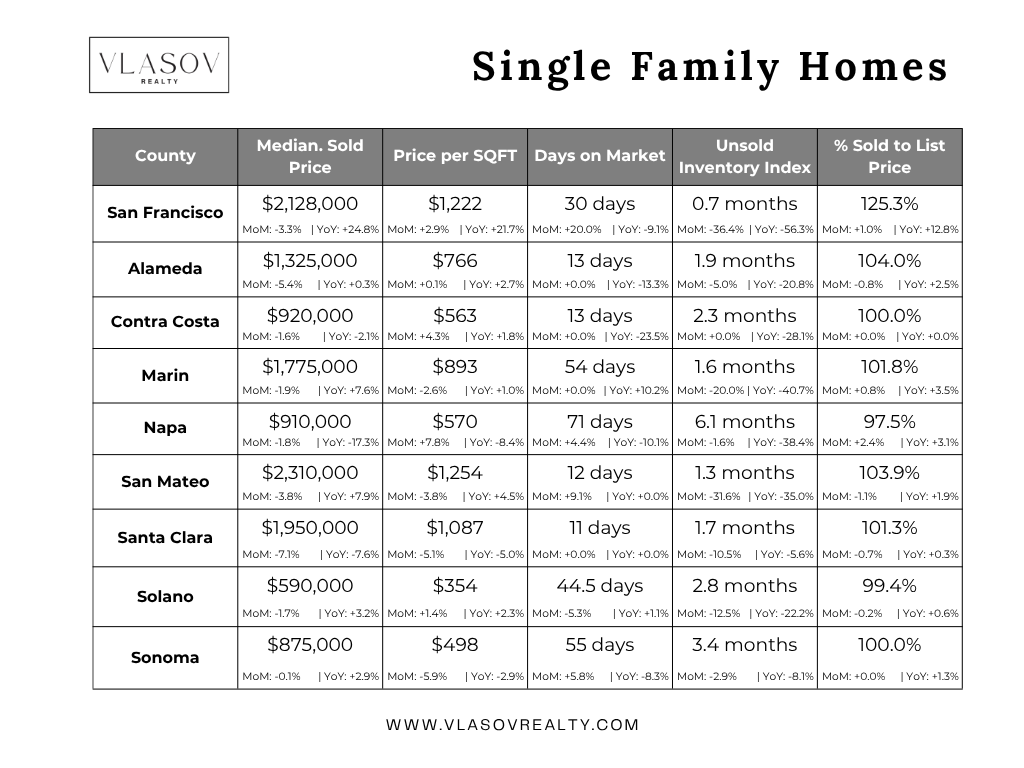
San Francisco is the headline of this report. The median single family home sold for $2,128,000 in June, up 24.8% from June 2025, the strongest year over year gain of any Bay Area county. Homes there sold in an average of 30 days and fetched 125.3% of asking price, the kind of overbidding usually reserved for the tightest pockets of the Peninsula. San Mateo held the highest median in the region at $2,310,000, and Santa Clara wasn't far behind at $1,950,000, though both counties saw prices pull back from May's spring peak.
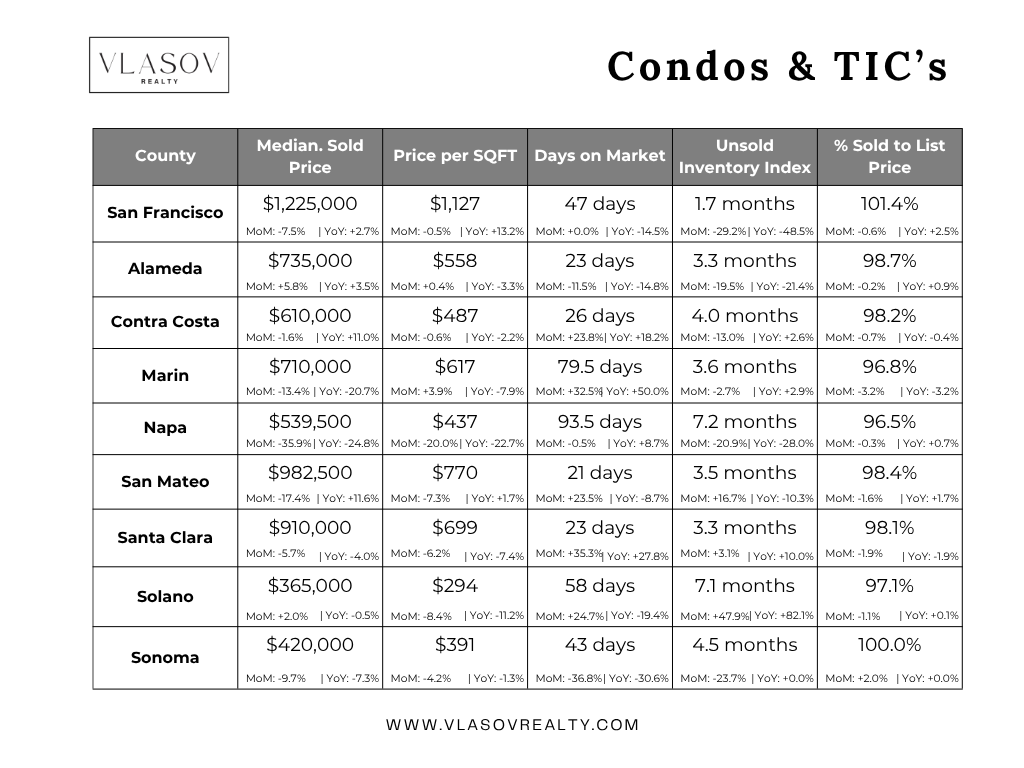
Across the nine counties, the pattern in June was consistent: prices dipped from May almost everywhere, even in markets still up sharply from a year ago. Inventory stayed lean. San Francisco's unsold inventory index sat at just 0.7 months, meaning homes would sell out in under five weeks at the current pace if no new listings hit the market. Napa was the loosest county by far, with 6.1 months of unsold inventory and homes taking an average of 71 days to sell. Condos told a more mixed story. San Francisco condo buyers paid 101.4% of list price, a sign that condo demand is starting to close the gap with the red hot single family market.
What's Driving the Market
The AI wealth wave is repricing San Francisco. Tech compensation tied to OpenAI, Anthropic, and the broader AI sector is showing up directly in home prices. Redfin has estimated that employees at the two companies could theoretically buy a meaningful share of San Francisco's housing stock once anticipated IPOs convert paper wealth into cash, and some sellers are already fielding offers with stock consideration built into the terms.
Mortgage rates climbed through the month. The 30 year fixed rate rose from 6.43% in early July to 6.58% by July 23, its highest level in about eleven months. That uptick likely contributed to the broad pullback in closed prices from May to June, since buyers who locked in rates a month or two earlier were shopping under a different cost of borrowing.
Inventory stayed historically tight in the core counties. San Francisco, Santa Clara, and San Mateo all posted unsold inventory under two months, and San Francisco's supply dropped 56% from a year ago. Tight supply is propping up prices even where demand has cooled.
Condo demand is picking up unevenly. San Francisco and Contra Costa condo buyers are paying closer to full price, while smaller counties like Napa and Marin saw condo prices swing sharply month over month, more a sign of thin sales volume than a real shift in value.
County Highlights
San Francisco. The city remains the epicenter of Bay Area price growth, with the median single family home at $2,128,000, up 24.8% year over year and down 3.3% from May. Homes sold in an average of 30 days at 125.3% of list price, and unsold inventory dropped 56% from a year ago to just 0.7 months of supply. AI sector compensation is the clear driver, with buyers competing hard for anything move in ready in a market that simply doesn't have enough listings.
Alameda. The median single family home sold for $1,325,000, essentially flat from a year ago at up 0.3%, though down 5.4% from May. Days on market held at 13, among the fastest in the region, and unsold inventory fell 21% year over year to 1.9 months. Oakland and the surrounding cities are benefiting from buyers priced out of San Francisco and looking for relative value.
Contra Costa. The median came in at $920,000, down 2.1% from last June and down 1.6% from May. Homes moved quickly at 13 days on market, and unsold inventory tightened to 2.3 months, down 28% from a year ago. Condos here are a bright spot, with prices up 11% year over year, a sign that first time buyers are finding more room to compete than in the pricier core counties.
Marin. The median single family home reached $1,775,000, up 7.6% year over year but down 1.9% from May. Days on market stretched to 54, the longest of the wealthier counties, reflecting Marin's smaller and more seasonal sales pool. Unsold inventory dropped 41% from a year ago to 1.6 months, keeping sellers in a strong position despite the slower pace.
Napa. The median fell to $910,000, down 17.3% from a year ago and down 1.8% from May, the steepest year over year decline in the region. Homes sat for an average of 71 days, and unsold inventory stood at 6.1 months, the loosest market in the Bay Area. Wine country's second home and luxury buyers have pulled back with rates elevated, giving local buyers more negotiating room than they've had in years.
San Mateo. The Peninsula's median single family home hit $2,310,000, the highest in the region, up 7.9% year over year despite a 3.8% pullback from May. Homes sold in just 12 days, and unsold inventory fell 35% from a year ago to 1.3 months. Proximity to both San Francisco's AI wealth and the Peninsula's established tech campuses keeps demand deep here.
Santa Clara. The median dropped to $1,950,000, down 7.6% from a year ago and down 7.1% from May, the sharpest monthly decline in the county data. Days on market held flat at 11, still the fastest in the Bay Area, and unsold inventory actually tightened another 6% from a year ago. That combination looks less like weak demand and more like a shift toward smaller, less expensive homes selling relative to last June's mix.
Solano. The median reached $590,000, up 3.2% year over year and down 1.7% from May. Days on market averaged about 45, and unsold inventory dropped 22% from a year ago to 2.8 months. Solano remains the affordability release valve for Bay Area buyers stretched by prices closer to the coast.
Sonoma. The median settled at $875,000, up 2.9% from a year ago and roughly flat from May. Homes took an average of 55 days to sell, and unsold inventory improved 8% year over year to 3.4 months. Wine country buyers here have been steadier than in Napa, with prices holding their ground through the summer.
Macro Market Overview
Nationally, the median existing home price reached $440,600 in June, an all time high and up 1.8% from a year ago, according to the National Association of Realtors. Sales slipped 2.4% from May to a seasonally adjusted annual pace of 4.09 million, and inventory crept up to 4.6 months of supply, still below the 5 to 6 months that typically signals a balanced market. The national picture is one of prices grinding higher even as sales volume cools, a pattern that echoes what happened in several Bay Area counties this month.
California's statewide median home price came in at $904,640 in June, down 2.8% from May's record of $930,260 but still up 0.4% from a year ago. Statewide sales rebounded to a seasonally adjusted annualized pace of 279,880, according to the California Association of Realtors, as buyers who had been sitting out returned once rates stabilized in the mid 6% range earlier in the summer. The state's price growth trails the Bay Area's core counties by a wide margin, a reminder of how concentrated this cycle's gains are in San Francisco and the Peninsula.
Economic Factors
Inflation cooled more than expected in June, with the Consumer Price Index falling 0.4% for the month and the annual rate dropping to 3.5%, below the 3.8% economists had forecast. Core inflation, which strips out food and energy, held flat for the month at a 2.6% annual pace, with shelter costs rising just 0.1%, one of the smallest monthly gains in years. That's a meaningful signal for the Federal Reserve, which meets again on July 29 and is widely expected to hold its benchmark rate at 3.5% to 3.75% for a fifth straight meeting, though a vocal minority of policymakers are pushing back given how hot growth has run elsewhere in the economy.
The stock market keeps setting the tone for buyer confidence, with the S&P 500 notching 24 record closes so far in 2026 and extending an eleven year streak of positive Julys. That kind of equity wealth flows directly into down payments and all cash offers in a market like San Francisco, where a meaningful share of buyers are paid partly in stock. The 10 year Treasury yield has eased to around 4.67% to 4.69% after a run higher earlier in the month, and the dollar index has held in a narrow band near 100 to 101, both signs that bond markets are comfortable with the inflation trend even while waiting on the Fed's next move.
Mortgage Rates
Freddie Mac's latest survey put the 30 year fixed rate at 6.58% for the week of July 23, its highest level in about eleven months and up from 6.43% just three weeks earlier. The 15 year fixed climbed alongside it to 5.96%, also its highest point since last summer. Both rates are actually a touch different from where they sat a year ago, with the 30 year down from 6.74% and the 15 year up slightly from 5.87%, but the direction this month has clearly been upward, and that shift shows up in the pullback in closed prices from May to June across nearly every Bay Area county.
What's pushing rates higher right now is a mix of sticky long term inflation expectations and a bond market still working out whether the Fed will hold steady or lean hawkish at its July 29 meeting. Most analysts expect rates to stay in the mid 6% range through the rest of the summer, with any meaningful drop dependent on clearer signs that inflation keeps cooling toward the Fed's target. For buyers, that means the rate environment probably isn't getting dramatically better before fall, so locking in a rate you can afford today usually beats waiting on a forecast. For sellers, it means pricing realistically matters more than it did this spring, when almost anything sold fast regardless of the number on the sign.
Housing Policy and Development
- SB 79 took effect July 1 and now overrides local zoning near major transit stops, allowing multi family buildings on lots that were previously zoned single family within about half a mile of BART, light rail, and bus rapid transit lines.
- San Francisco's Family Zoning Plan received state approval on July 1, opening the Sunset, the Richmond, West Portal, and the Marina to two and three unit buildings, with height limits along transit corridors rising as high as 65 to 85 feet in some areas.
- SB 543 strengthens ADU rights statewide, blocking cities from charging impact or school fees on junior ADUs and confirming that most single family lots can now add one detached ADU, one interior conversion, and one JADU.
- AB 462 streamlines coastal zone ADU permits, cutting red tape for homeowners near the coast who want to add a unit.
- AB 130 adds a new infill CEQA exemption, making it faster and cheaper to build housing on already developed urban parcels across the state.
Local Insight
On the ground, June felt like two different markets stitched together. In San Francisco and San Mateo, multiple offer situations are back in neighborhoods that had gone quiet the past couple of years, and buyers who lost out on a home once are coming back faster and bidding harder the second time. In Napa and Sonoma, it's the opposite story: sellers are having real conversations about price, and buyers who show up with financing in order are getting real leverage for the first time in a while.
The rate uptick this month took some of the edge off, and more buyers are pausing to run the numbers again before writing an offer instead of rushing in. That's healthy. A market that lets people think for a week without losing the house is a better market for almost everyone, sellers included, since the buyers who do show up tend to be serious.
If you're weighing a move in the second half of 2026, whether that means buying before rates or prices climb further, or selling while your county's numbers are still working in your favor, I'd rather talk through your specific situation than have you guess from a report. Reach out and let's look at what June's numbers actually mean for your street, your county, and your timeline.
Categories
Recent Posts









Stay In The Know - Subscribe To Market Updates
LET'S GET IN TOUCH