
Bay Area Residential Market Report: August 2026

Bay Area Residential Market Report: August 2026
Summer is winding down, kids are back in school, and the Bay Area housing market is doing something it always does this time of year: taking a breath. July's closed sales show prices pulling back from June across most counties, but don't mistake that for weakness. San Francisco single family homes are still up 25 percent from a year ago, tech wealth is chasing a shrinking pool of listings in the core counties, and mortgage rates have settled into a holding pattern that isn't going anywhere fast. If you're trying to figure out whether now is the moment to buy, sell, or wait, here's what the numbers actually say.
Local Market Insight
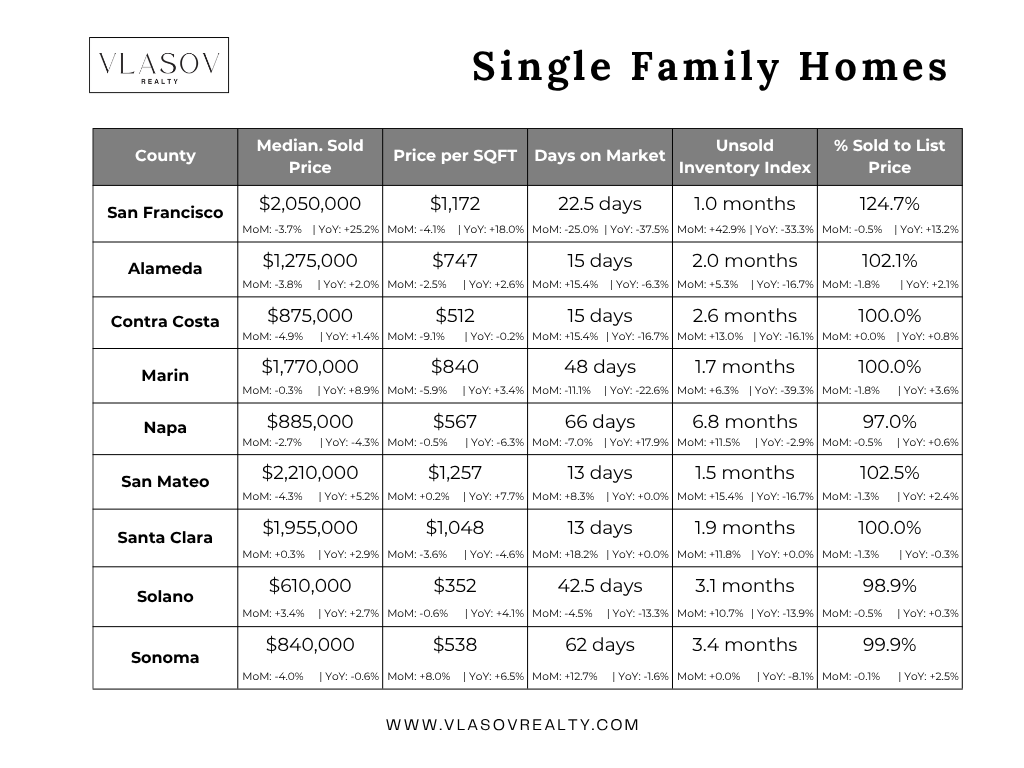
July was a study in contrasts. San Francisco single family homes sold for a median of $2,050,000, up a striking 25.2 percent from a year ago, even after slipping 3.7 percent from June's pace. San Mateo held the highest price point in the region at $2,210,000, and Santa Clara wasn't far behind at $1,955,000. Inventory in these core counties remains genuinely tight: San Francisco's unsold inventory index sits at just 1.0, meaning listings are moving almost as fast as they arrive, and San Mateo and Santa Clara aren't far above that.
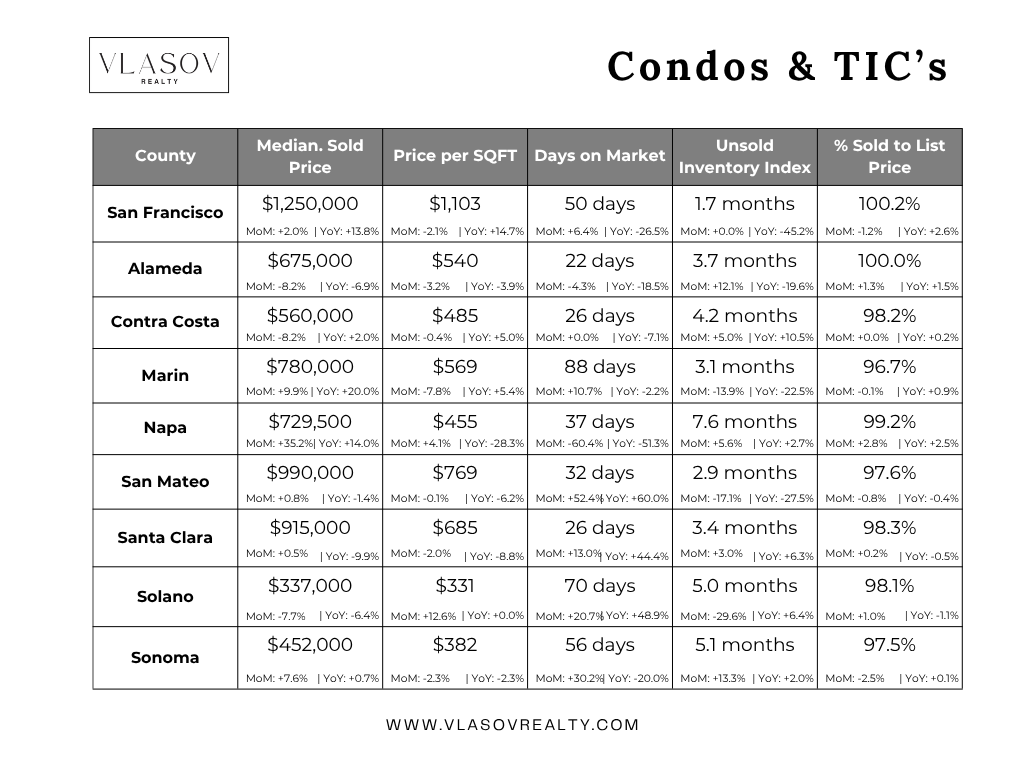
Outside the AI-wealth corridor, the picture softens. Solano's median single family price came in at $610,000 and Sonoma at $840,000, both showing much smaller year over year moves and longer days on market. Condos told a similar split story: San Francisco condos jumped 13.8 percent year over year to $1,250,000, while Santa Clara condos actually fell 9.9 percent from last July to $915,000. This is a market moving in two speeds at once, and which speed you experience depends heavily on price point and location.
What's Driving the Market
AI wealth is rewriting the luxury map. The AI boom is putting real money into the hands of Bay Area buyers, and it's showing up in the data. Buyers on luxury homes in the greater San Francisco area brought a median down payment of 35 percent of the purchase price in 2025, up sharply from a few years ago, and this summer saw dozens of Bay Area homes close a full million dollars or more over asking. That kind of buying power is concentrated in specific pockets, mostly near the big tech and AI employers, and it's a major reason San Francisco, San Mateo, and Santa Clara are running so far ahead of the rest of the region.
Mortgage rates are stuck, not falling. The 30 year fixed has held in the mid 6 percent range all summer with no real relief in sight. Buyers who were waiting for a rate drop to bring them off the sidelines are instead adjusting their expectations and moving forward anyway, which is part of what's kept the tighter counties competitive even with borrowing costs elevated.
Inventory still can't keep up in the core counties. An unsold inventory index near 1.0, like San Francisco's, is about as tight as this market gets. When there's barely a month of supply sitting on the market, sellers keep the upper hand no matter what the rate environment looks like, and multiple offer situations stay common on well priced listings.
The late summer pullback is real, and it's normal. Every county in our dataset except Santa Clara and Solano posted a lower median single family price in July than in June. That's a seasonal pattern, not a warning sign. Families finish moving before the school year starts, showing traffic slows, and prices ease slightly from the spring and early summer peak. It happens most years, and this year is no exception.
County Highlights
San Francisco. Single family homes sold at a median of $2,050,000, up 25.2 percent year over year but down 3.7 percent from June. Homes went for 124.7 percent of list price on average, the strongest sale to list ratio in the region, and days on market dropped to just under 23. Condos moved up too, 13.8 percent year over year to $1,250,000, though they're taking about 50 days to sell versus roughly three weeks for single family homes. AI and tech hiring is the clear driver here.
Alameda. The median single family price held at $1,275,000, a modest 2.0 percent gain year over year and a 3.8 percent dip from June. Homes are selling in about 15 days at 102.1 percent of list price, a sign the market here is steady rather than frenzied. Condos softened more, down 6.9 percent year over year to $675,000, as buyers continue to favor single family stock.
Contra Costa. Single family median price sits at $875,000, up 1.4 percent from last July and down almost 5 percent from June. At 15 days on market and 100 percent of list price, this remains one of the more balanced counties in the region, offering relative affordability without the bidding war intensity seen closer to the Peninsula. Condos are holding near $560,000, roughly flat year over year.
Marin. The median single family home sold for $1,770,000, up 8.9 percent year over year, though days on market stretched to 48, more than double San Francisco's pace. Condos in Marin jumped 20 percent year over year to $780,000, the strongest condo gain anywhere in the region, even as they sat on the market for nearly three months on average. Marin's story this month is scarce inventory meeting patient, well qualified buyers.
Napa. Single family median price came in at $885,000, down 4.3 percent from a year ago, with days on market at 66, the longest stretch in the county's single family data this cycle. Wine country's second home and lifestyle buyer pool has cooled compared to the frenzy of a few years back. Condos, by contrast, spiked 14 percent year over year to $729,500, though on very thin volume that makes month to month swings noisy.
San Mateo. The Peninsula's median single family price led the entire region at $2,210,000, up 5.2 percent year over year, with homes selling in just 13 days at 102.5 percent of list price. This is AI and big tech money at its most concentrated. Condos held near $990,000, essentially flat from a year ago, as buyers here keep gravitating toward detached homes when they can afford them.
Santa Clara. Silicon Valley's core county posted a median single family price of $1,955,000, up 2.9 percent year over year, with an unusually fast 13 day average time on market. Santa Clara was one of the few counties where prices actually rose slightly from June, up 0.3 percent, bucking the seasonal pullback seen elsewhere. Condos pulled back 9.9 percent year over year to $915,000, suggesting entry level tech workers are feeling the affordability squeeze even as executive level buyers push single family prices higher.
Solano. The most affordable county in our dataset, Solano's median single family price sits at $610,000, up 2.7 percent year over year and one of only two counties to post a month over month gain, rising 3.4 percent from June. Days on market ran longer at just over 42 days. Solano continues to serve as the release valve for Bay Area buyers priced out of the core counties.
Sonoma. Median single family price came in at $840,000, down slightly, 0.6 percent, from last July, with days on market at 62. Sonoma's price per square foot actually rose 6.5 percent year over year even as the median price dipped, pointing to a shift toward smaller, more efficient homes selling at a premium per foot. Condos ticked up 0.7 percent year over year to $452,000.
Macro Market Overview
Nationally, the median existing home price was $434,100 in July, according to the National Association of Realtors, marking the 37th straight month of year over year gains, up 2.0 percent from last July. That said, the national median actually eased from June's $440,600, a seasonal dip of roughly 1.5 percent that mirrors what we're seeing across most Bay Area counties. Existing home sales fell 1.7 percent from June to a seasonally adjusted annual rate of 4.06 million, though sales are still up 0.7 percent from a year ago, and national inventory holds at a 4.6 month supply, still well below the six months that typically signals a balanced market.
California told a similar story. The statewide median home price was $887,680 in July, per the California Association of Realtors, down 1.9 percent from June's $904,640 but up 0.3 percent from $885,180 a year ago. The statewide median price per square foot slipped slightly to $434, homes sold faster at a median of 26 days versus 28 a year earlier, and the sale to list price ratio improved to 99.3 percent from 98.5 percent last July. California's market, like the Bay Area's, is cooling from its summer peak while still running ahead of where it stood a year ago.
Economic Factors
Inflation cooled slightly in July, with the consumer price index rising just 0.1 percent for the month and 3.4 percent annually, down from 3.5 percent in June. The Fed's preferred gauge, the personal consumption expenditures index, told a slightly different story, rising 0.2 percent for the month and 3.7 percent annually, ahead of forecasts and a reversal from June's small decline. That mixed inflation picture is exactly why the Federal Reserve held its benchmark rate steady at 3.50 to 3.75 percent at its late July meeting, a decision that passed 9 to 3, with three regional bank presidents dissenting in favor of a hike. It's an unusually hawkish split for this stage of the cycle, and it's kept markets on edge about what happens at the Fed's next meeting in mid September.
The stock market has stayed remarkably strong through all of this. The S&P 500 closed above 7,800 for the first time in history in mid August on cooler than expected inflation data, before easing back toward 7,700 late in the month as a more hawkish tone from the Fed pushed rate hike expectations higher. The index is still up more than 19 percent from a year ago. The 10 year Treasury yield, meanwhile, climbed to around 4.66 percent in the final week of August as stronger economic data reinforced bets on a Fed hike before year end, and the dollar index has held near 98.8 amid ongoing uncertainty over fiscal policy and the path of rates. Taken together, a resilient stock market and AI driven job growth are propping up buyer confidence in the Bay Area even as borrowing costs stay elevated.
Mortgage Rates
The 30 year fixed averaged 6.66 percent in Freddie Mac's most recent weekly survey, essentially unchanged from 6.65 percent the week before and only modestly higher than the 6.56 percent recorded a year ago. The 15 year fixed came in at 5.98 percent, up from 5.95 percent the prior week. Rates have spent the entire summer in a narrow band in the mid 6 percent range, held there by a Fed that's staying cautious on inflation and a bond market that's been pricing in the possibility of a rate hike rather than a cut before year end.
Most forecasters don't see much relief coming soon. The Mortgage Bankers Association projects 30 year rates around 6.5 percent through the rest of 2026, while Fannie Mae's outlook points to roughly 6.4 percent. The general consensus among housing economists is that rates hold in the 6.0 to 6.5 percent range through year end barring a clear break in inflation data. For buyers, that means the rate you see today is a reasonable planning number for the rest of the year, not something to wait out. For sellers, it means the buyer pool that's active right now, people who've made peace with mid 6 percent financing, is likely the buyer pool you're working with through the fall.
Housing Policy and Development
- Senate Bill 79 took effect July 1, 2026, overriding local density limits to allow higher density housing near major transit stations across the Bay Area, Southern California, and Sacramento, and giving transit agencies new authority to set zoning on their own land within those corridors.
- A package of ADU reforms exempts smaller units from major fees: accessory and junior accessory units of 500 square feet or less are now exempt from school impact fees, and units up to 750 square feet are exempt from development impact fees.
- Cities now face a firm 15 business day window to review ADU applications for completeness and must provide a written list of any deficiencies, aimed at cutting the permitting delays that have slowed projects across Bay Area cities.
- Assembly Bill 1154 loosens owner occupancy rules for junior accessory dwelling units that include their own bathroom, opening the door to more rental flexibility for homeowners and small investors.
- Assembly Bill 462 puts ADU coastal development permits on the same 60 day review clock as inland projects and removes the option to appeal ADU permit decisions to the Coastal Commission, a meaningful change for coastal cities from Marin to Sonoma.
- San Jose and other South Bay cities continue expanding ordinances that allow ADUs to be sold separately from the main home, opening a new, lower cost path to ownership in some of the region's priciest zip codes.
Local Sentiment
What I'm hearing from other agents matches what the numbers show: this is a market that rewards patience in some counties and demands speed in others. In San Francisco, San Mateo, and Santa Clara, well priced listings are still drawing multiple offers within days, and buyers backed by tech and AI compensation are showing up ready to move fast and pay a premium for the right property. Further out, in Solano, Sonoma, and Napa, buyers have more room to negotiate and more time to think it through.
The rate environment hasn't scared people off, it's just changed how they plan. Buyers I'm working with have stopped waiting for a rate drop and started asking better questions about what they can actually afford at today's numbers, which is a healthier place to be than hoping for a market that isn't coming. If you're weighing a move this fall, the most useful thing you can do is get a clear, current read on what your specific neighborhood and price point are doing, since the county averages above can hide a lot of variation block to block. Reach out and I'll walk you through exactly what's happening where you're looking to buy or sell.
Categories
Recent Posts









Stay In The Know - Subscribe To Market Updates
LET'S GET IN TOUCH